
Therapy may be individual. Clients still live within relationships and systems. Therapists often work with relationships, not just individuals. With PracticeRunner, a couple, family, or therapy group can be the case itself. You do not have to use one client as a stand-in for everyone else or reconstruct the case as a list of clients attached to a recurring appointment. Each participant keeps an individual identity and appropriate access, while attendance, documentation, communication, billing, and payments stay connected to the shared case over time.
A common EHR structure starts with one person, one chart, and one payer. That can work well for individual therapy. Work with couples, families, and groups becomes harder when the software requires the therapist to choose one person as the owner, duplicate shared information across several charts, or rebuild the group around every appointment.
PracticeRunner starts with a broader organizing concept: the case. An individual client, couple, family, or therapy group can each be a case in its own right. The people, appointments, attendance, documentation, and practical history stay connected across sessions while each participant keeps a distinct identity, contact information, portal access, and responsibilities.
The individualistic assumption in practice software
Individual charts answer an important question: what belongs to this person? Therapists working with couples, families, and groups also need the software to answer another question: what belongs to the work being done together?
If the EHR does not treat the relationship as a case, therapists create workarounds. A couple may live under one partner's chart. Family information may be copied into several individual charts. A therapy group may exist only as a repeating calendar event. Attendance, billing, communication, and notes can end up organized differently depending on which screen is open.
That can create a negative cycle. Missing context leads to workarounds, the workarounds scatter more context, and the next appointment requires the therapist or staff to reconstruct the relationship again. The problem is the workflow, not the therapist.
Couples therapy without choosing an owner
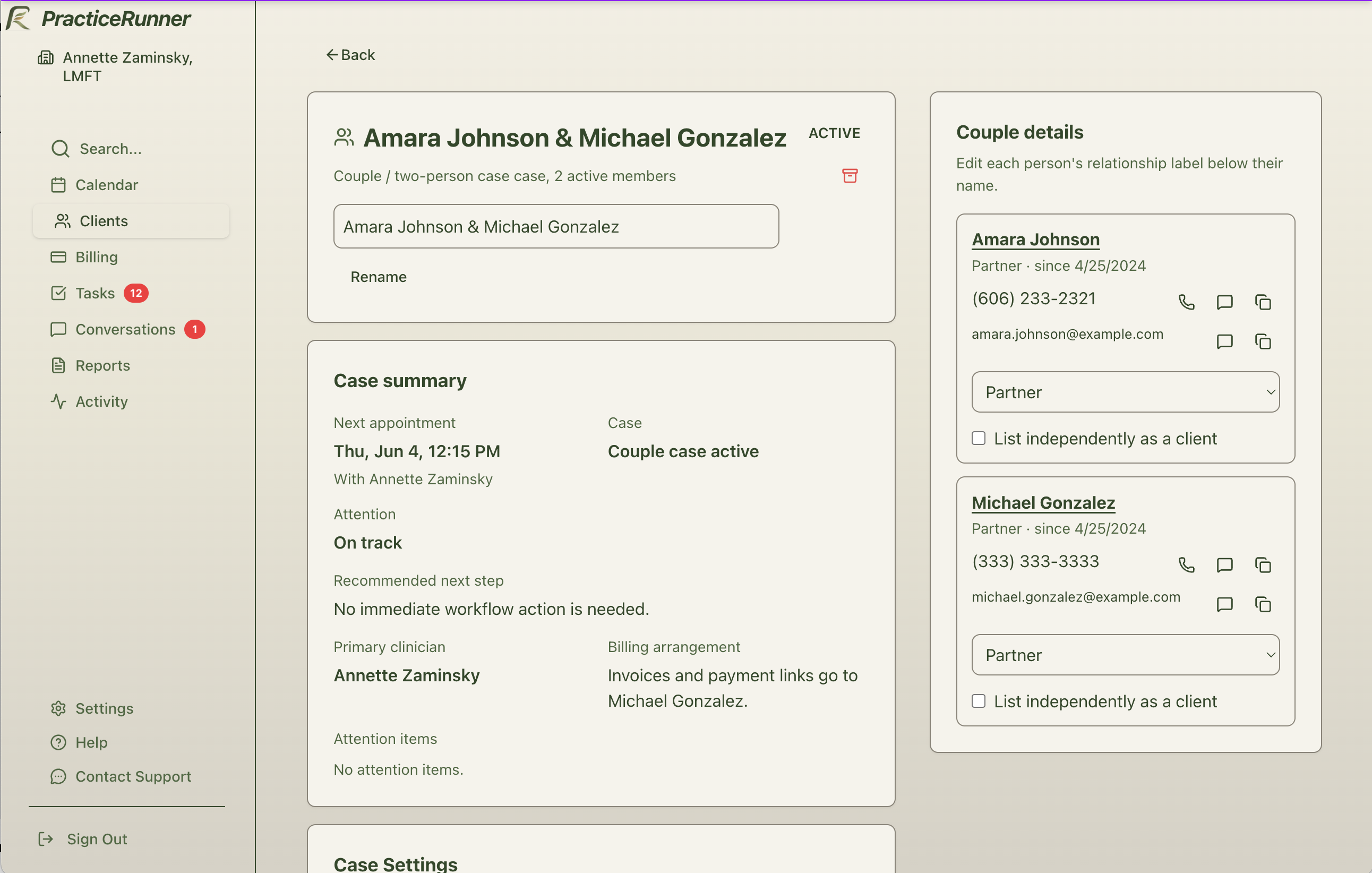
In couples therapy, the work belongs to the couple even though the participants remain two separate people. A shared case can hold the couple's appointments, shared notes, communication, billing history, and scheduling context without making one partner the administrative center of the relationship.
PracticeRunner keeps both people connected to the couple case. Each partner can retain distinct contact details, portal access, and relevant responsibilities. Shared session documentation stays with the couple, while a client-specific note addendum can remain in one person's own record when sensitive information should not become part of the shared case note.
A family is more than several records sitting next to each other
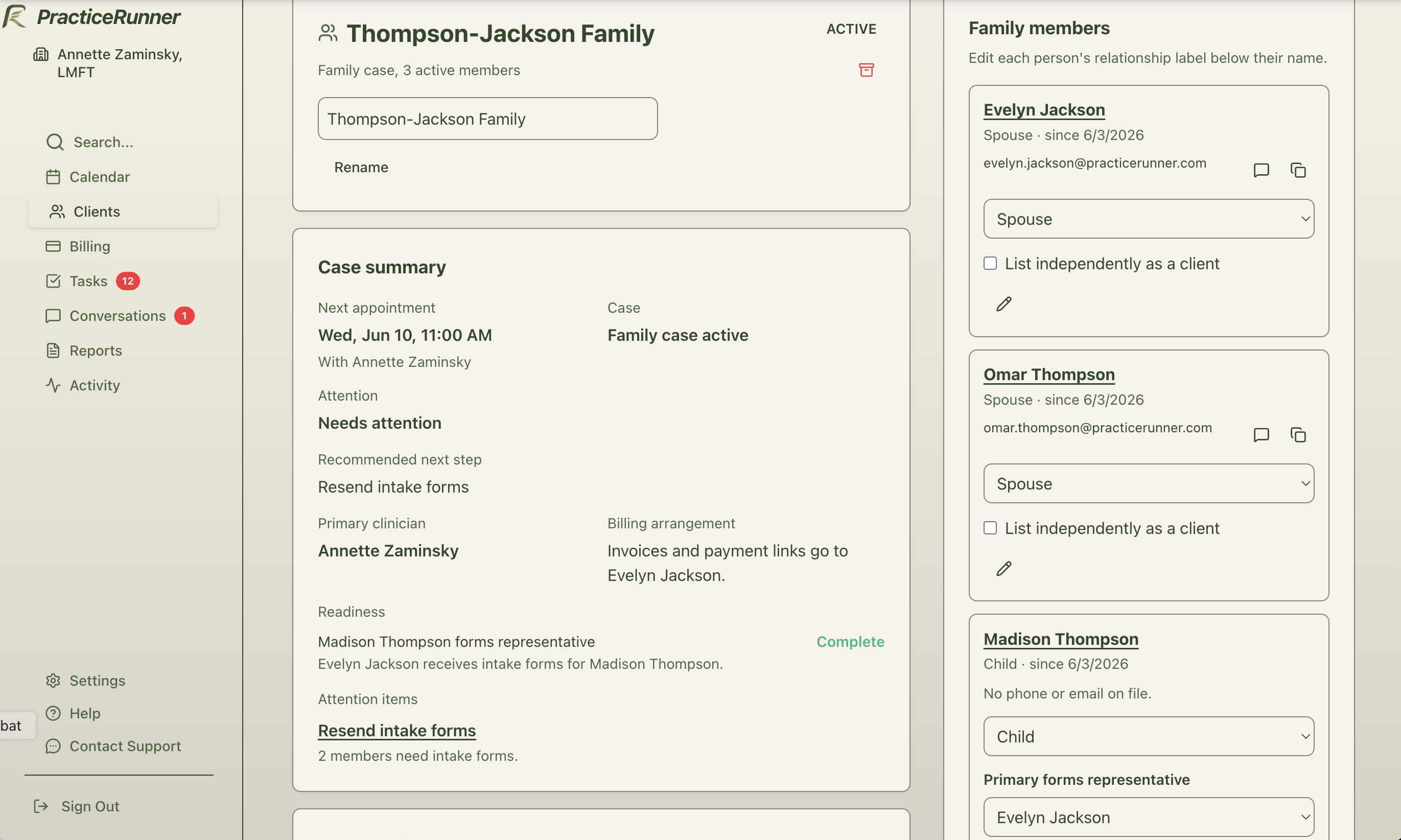
Family participation can change from session to session. A parent may attend alone, a child may join the next appointment, and another caregiver may become involved later. The family can remain the organizing structure even as attendance and administrative roles change.
PracticeRunner keeps the participant roster, shared appointments, attendance, documentation, communication, and billing connected to the family case. A parent, guardian, or other approved person can handle a specific responsibility without being presented as the person receiving therapy. The clinical frame can stay stable while the practical details remain flexible.
A therapy group needs more than a recurring appointment
An ongoing therapy group has continuity of its own. It has a roster, a history, recurring appointments, attendance, group documentation, communication, and often participant-specific billing. Treating it only as a calendar event means rebuilding that structure every time the group meets.
In PracticeRunner, the therapy group remains the case between meetings. Attendance records who was present for a particular session without dismantling the group. Shared notes stay with the group, while participant-specific details can remain connected to the appropriate person. Scheduling, portal access, forms, messages, invoices, and payments remain part of the same operational model. The exact boundary between participant invoices, superbills, and CMS-1500 claims is documented separately.
Connected does not mean collapsed
A relationship case should preserve context without erasing boundaries. Keeping people connected to one case does not mean everyone should see the same information or receive the same communication.
In PracticeRunner, the case provides continuity while responsibilities remain distinct. Depending on the situation, one person may receive care, another may sign forms, another may manage scheduling, and another may pay. Portal access, messages, forms, billing notifications, and clinical documentation still require deliberate access decisions.
This distinction matters for couples, families, and groups. The software needs to represent the relationship and still respect that each participant has an individual identity, role, and privacy boundary.
Billing follows responsibility, not an artificial chart owner
Work with couples, families, and groups often includes practical arrangements that do not fit one-client, one-payer assumptions. One partner may manage payment for a couple. A parent may pay for a child's care. Family members may have different portal access. Therapy-group participants may each have separate payment arrangements.
PracticeRunner separates the case from the billing contact. The relationship can remain the clinical and operational center while invoices, payment methods, receipts, reminders, and other billing responsibilities go to the appropriate person. That keeps the financial workflow clear without reorganizing the clinical work around whoever pays.
What to ask an EHR about relationship cases
A feature list may say that an EHR supports couples, families, or groups. The more useful question is how the software represents them after the appointment has been scheduled.
What stays connected across appointments?
Does the couple, family, or group remain intact across appointments, or is it reconstructed from individual charts and calendar events?
How does participation change?
Can attendance vary by session without changing who belongs to the case?
Where does documentation belong?
Can shared documentation remain with the relationship while participant-specific information stays appropriately separate?
Who can do what?
Can portal access, forms, communication, scheduling, and billing responsibilities differ by participant or approved helper?
What happens as the practice grows?
Can the same model support associates, supervisors, administrators, consultation, and workshops without rebuilding the practice around another system?
One case model, language that fits the work
PracticeRunner uses cases as the broad organizing structure, but it does not force that word into every screen. The product uses the natural name for the work: client, couple, family, therapy group, consultation client, consultation group, or workshop group.
The underlying structure stays consistent. Scheduling, Session Workspace, notes, attendance, portal access, forms, secure communication, billing, payments, receipts, and follow-up remain connected to the relevant client or relationship. The available tools and language adapt to the service instead of making every participant look like an individual therapy client.
See the permanent PracticeRunner product page for couples, families, and therapy groups. For the detailed product model, read Practice Management for Couples, Families, and Groups and One Workflow for Therapy, Consultation, and Group-Based Care. You can also review the broader PracticeRunner workflow or see how the case structure compares with SimplePractice.
See whether the model fits
Bring the relationship into the record
PracticeRunner is available for independent therapists and growing practices, with hands-on onboarding and direct founder support during this early stage.