
One Workflow for Therapy, Consultation, and Group-Based Care
How PracticeRunner uses the same scheduling, documentation, billing, and communication workflows across therapy, consultation, and workshop cases.
As a practice grows, care often becomes more varied. A clinician may see individual clients, couples, families, groups, consultation clients, and workshop participants in the same week.
Many systems turn those differences into separate administrative processes.
The work can change shape without requiring a different administrative system each time. PracticeRunner keeps the core workflow familiar while still preserving the context of each kind of work. An individual client, couple, family, group, or professional service can each be a case in its own right, not just a collection of people added to individual appointments.
The goal
The goal is not to make every type of care identical.
The goal is to keep the day-to-day operations familiar.
Whether you are working with:
- an individual
- a couple
- a family
- a therapy group
- an individual consultation
- a consultation group
- a workshop or skills group
the practice should not have to relearn scheduling, billing, or documentation each time the shape of care changes.
If you are setting up a new account, start with Getting Started with PracticeRunner for the first settings to configure. This article explains how the same everyday tools adapt to individuals, couples, families, and groups.
For a side-by-side guide to consultation, workshop, therapy-group, couple, and family case types, see Choosing a Case Type for Consultation, Workshops, and Groups.
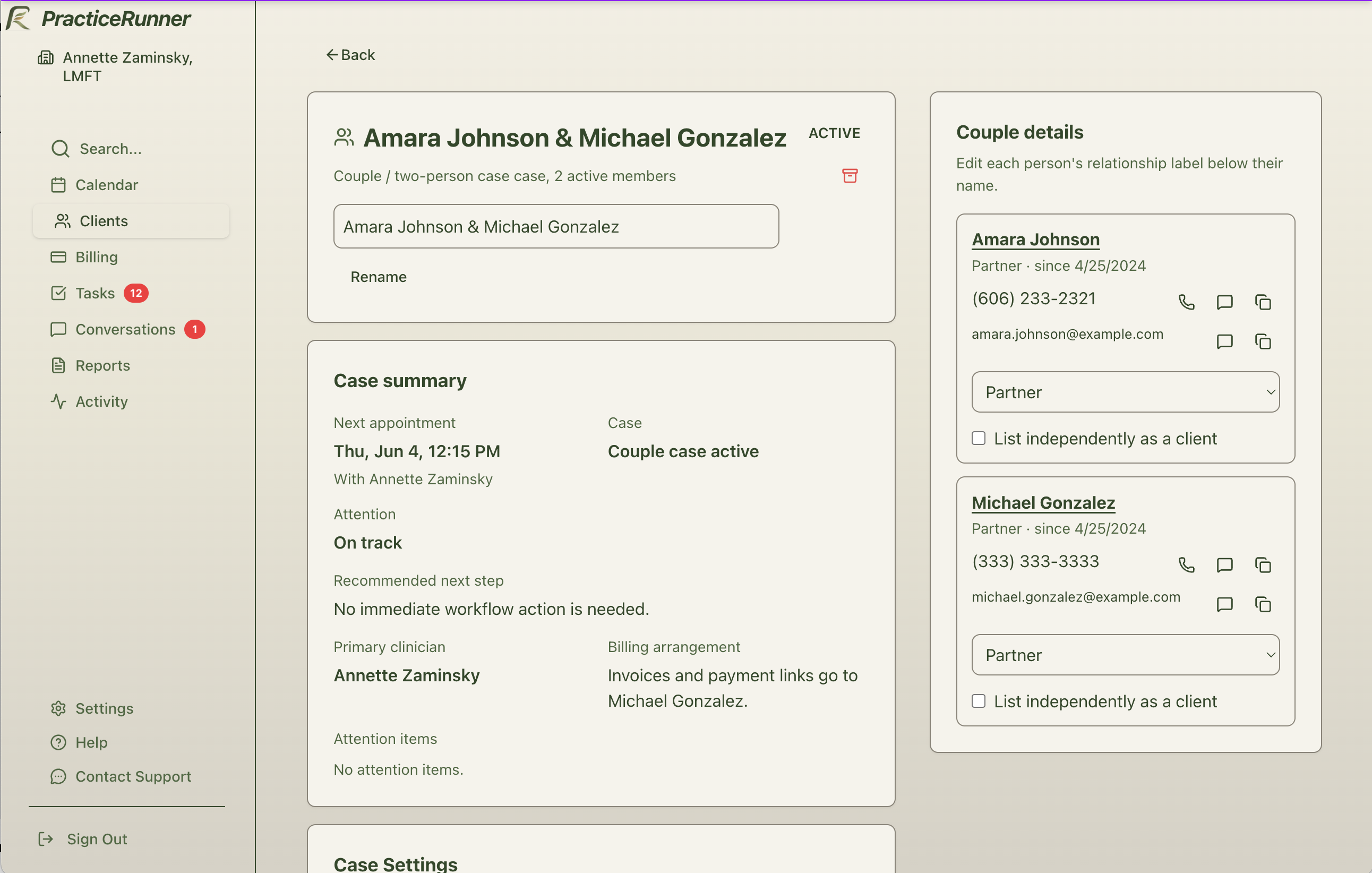
Couples can be organized around the relationship being treated, while each participant stays visible.
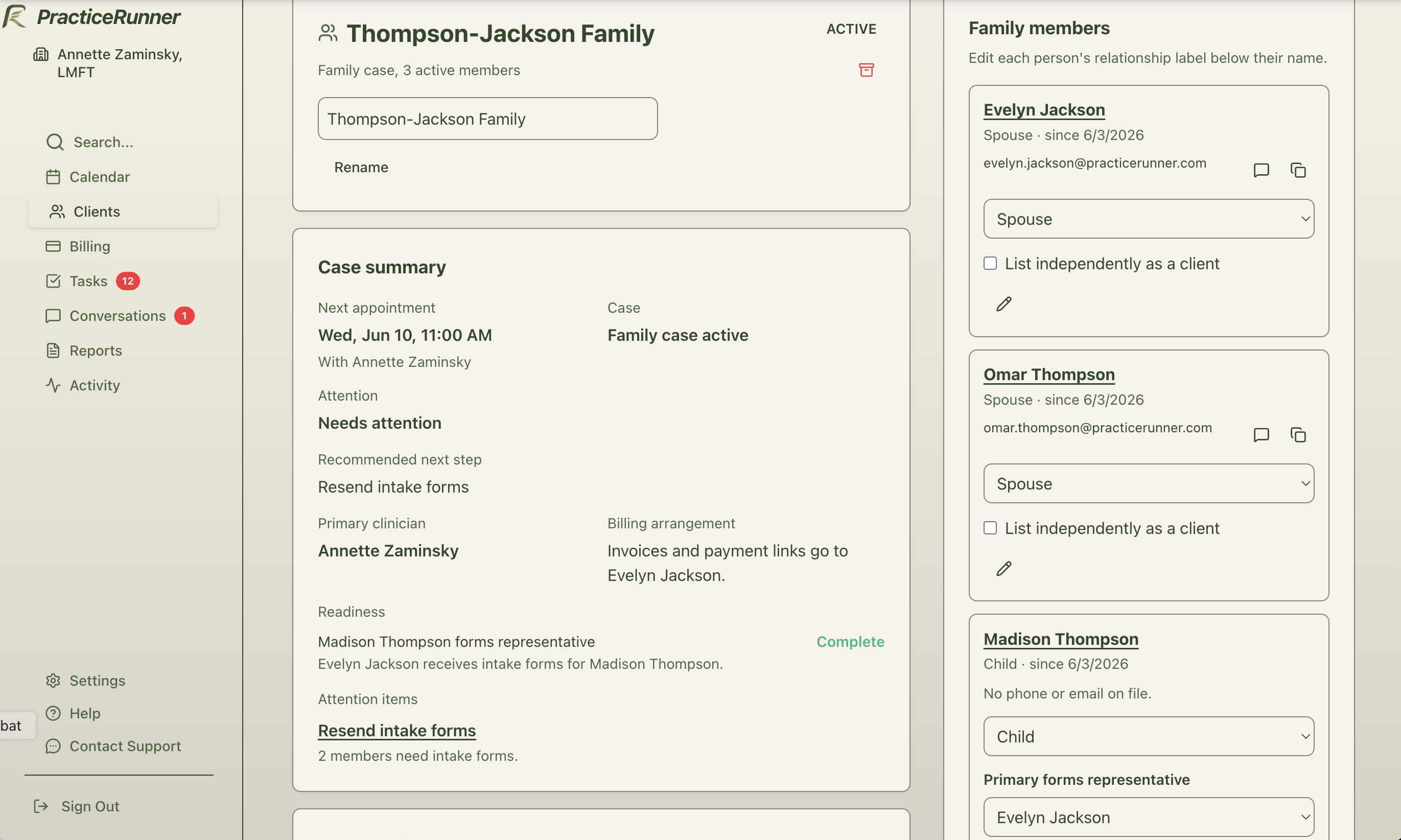
Families can keep participants, scheduling, communication, documentation, and billing responsibilities connected without duplicating workflows.
Scheduling
Scheduling begins from the person or case you are working with, whether that is an individual client, couple, family, group, or consultation relationship.
An appointment can belong to:
- an individual
- a couple or other two-person case
- a family
- a therapy group
- a consultation client
- a workshop group
The same calendar, recurring scheduling tools, reminders, portal workflows, and availability settings continue to work.
For new setup, this means your services, locations, scheduler settings, and availability blocks should reflect the real kinds of work you offer. For example, Consultation service and Workshop, class, or non-clinical service categories can have their own fees, locations, and scheduling rules without creating a separate administrative process.
Documentation
Documentation remains connected to the appointment and the case.
That means the same note workflow can support:
- individual sessions
- couples sessions
- family sessions
- group sessions
- consultation appointments
- workshop or skills group appointments
Consultation notes should use consultation language. Individual consultation and consultation groups do not require psychotherapy-specific fields such as diagnosis, treatment plan, or mental status exam by default.
Workshop groups can use group notes or session notes without psychotherapy-specific fields. Participants may be existing clients, consultation clients, or workshop-only participants, but the workshop case itself is not treated as psychotherapy.
Workshop participants do not need therapy intake by default. If they need an agreement, reading materials, payment authorization, or other information before the workshop, use Share Documents & Forms instead of a psychotherapy intake packet.
This is also why setup should not treat every form packet as universal. Use therapy intake for clients receiving therapy, consultation agreements for consultation cases, and shared documents or forms for workshop materials.
Billing
Billing is often where complexity appears. The participant is not always the payer: a parent may pay for a child, one partner may manage billing for a couple, and group participants may each have different payment arrangements.
A consultation client may be paying for professional consultation services rather than therapy.
A workshop group participant may be paying for a skills group, training, or business workshop that is not billed as psychotherapy.
PracticeRunner separates participation from billing responsibility so the billing workflow remains consistent while still supporting real-world arrangements. Consultation cases and workshop groups use invoices and receipts by default, not superbills.
Use Insurance-eligible service for therapy services that may appear on superbills or insurance claims. Use Consultation service for individual consultation, consultation groups, supervision, and practice consulting. Use Workshop, class, or non-clinical service for workshops and classes. Reserve Free call, paperwork, or non-session item for free intake calls, paperwork, and other non-session items.
When configuring billing in a new account, start with the defaults that fit most of your practice. Assign reusable payment profiles or custom collection schedules to cases that need a different arrangement, and use billing contacts to identify who receives invoices and owns the saved payment methods.
Portal and communication
The same principle applies to communication.
Portal access, secure messaging, shared forms, reminders, scheduling requests, and billing notifications can all be managed within the same overall workflow.
For clients receiving therapy, forms may be part of intake. For workshop groups, forms are usually shared as agreements, handouts, registration materials, payment authorizations, or other non-clinical documents.
For consultation cases, portal access can support scheduling, messages, documents, invoices, receipts, payment methods, and consultation forms without turning the case into psychotherapy.
The details change based on the situation, but the operational model stays familiar.
Staff workflows
The same approach extends to staff.
Owners, providers, associates, supervisors, and admins can work from the same operational system.
Tasks, workflow summaries, scheduling requests, billing follow-up, supervision review, and documentation reminders remain connected to the client, couple, family, therapy group, individual consultation, consultation group, or workshop group involved.
Designed around real-world practice
Many therapy practices do not stay in a single modality forever.
A clinician may begin with individual work, then add couples therapy. A family therapist may start a parenting group. A practice owner may add associates and support staff.
PracticeRunner is designed so those changes do not require rebuilding the practice around a different administrative structure.
The same operational workflow can support individuals, couples, families, therapy groups, workshops, and consultation services while preserving the practical context of the work.