
July's work centered on making PracticeRunner more useful during the session and more dependable around it. That included a new Session Workspace, more ways to turn source material into a draft note, stronger billing safeguards, clearer import review, first-class consultation cases, and the launch of the Practice Website Review.
I use PracticeRunner in my own therapy practice, and I am increasingly building alongside other solo therapists and group practices. That keeps the roadmap tied to specific work: preparing for a session, documenting it, getting invoices and payments right, and moving into the system without having to trust an import blindly.
The Session Workspace took shape
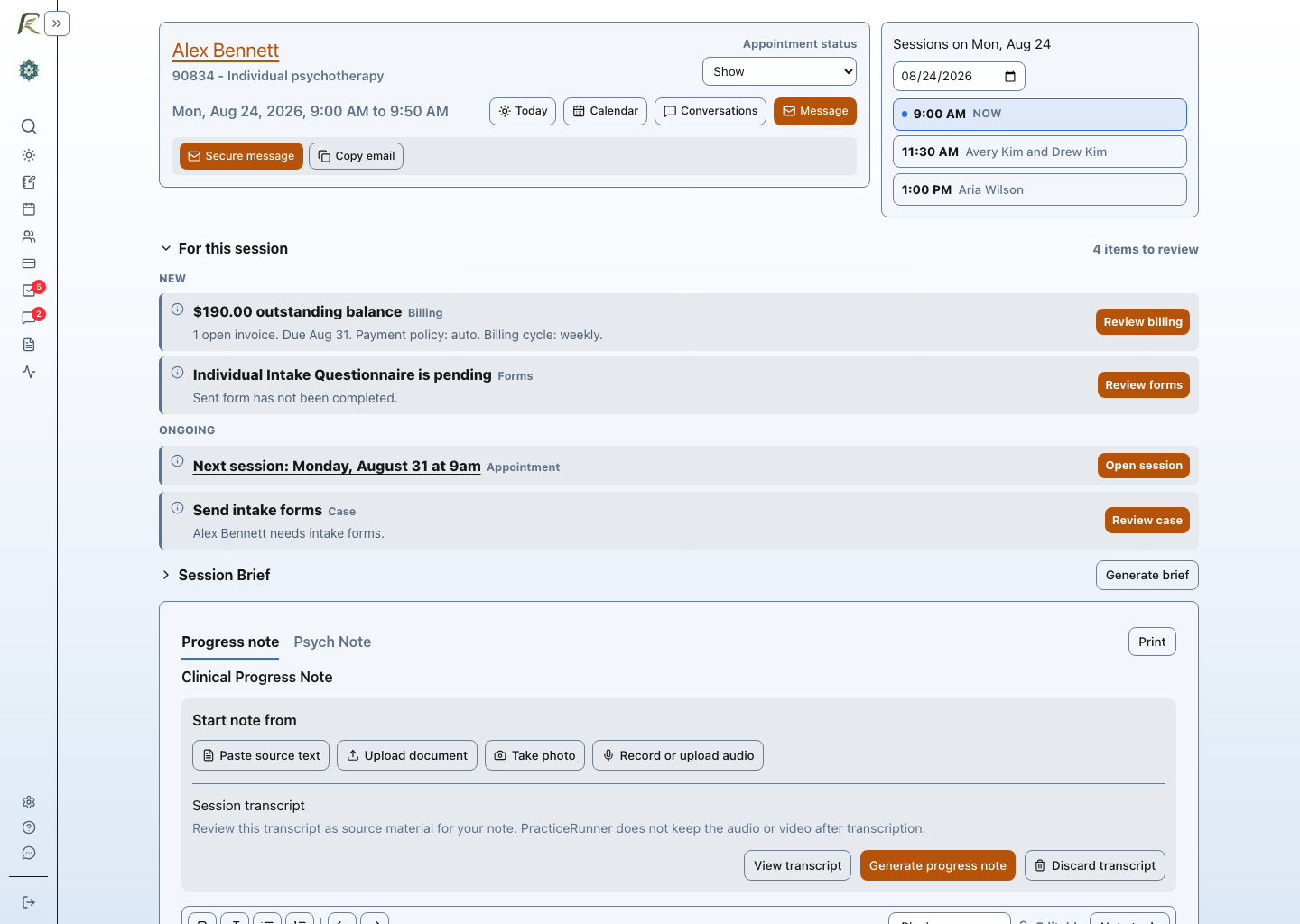
The largest product change in July was the Session Workspace, a single place to prepare for an appointment, work with source material, write the note, and see practical items that need attention.
An optional Session Brief can summarize relevant themes from recent signed notes before the appointment. A separate “For this session” area can surface concrete issues such as an overdue balance, failed payment, incomplete form, missing note, or scheduling concern. Keeping those administrative reminders separate means they do not need to be sent to an AI model.
The workspace also gained several ways to begin documentation. A therapist can type directly, record or upload audio or video for transcription, use existing text, or photograph a handwritten note. PracticeRunner can help organize that material into a draft, but the clinician reviews and edits the note before it becomes part of the clinical record.
Read more about turning handwritten notes into a clinician-reviewed draft →
Scheduling and calendars became more flexible
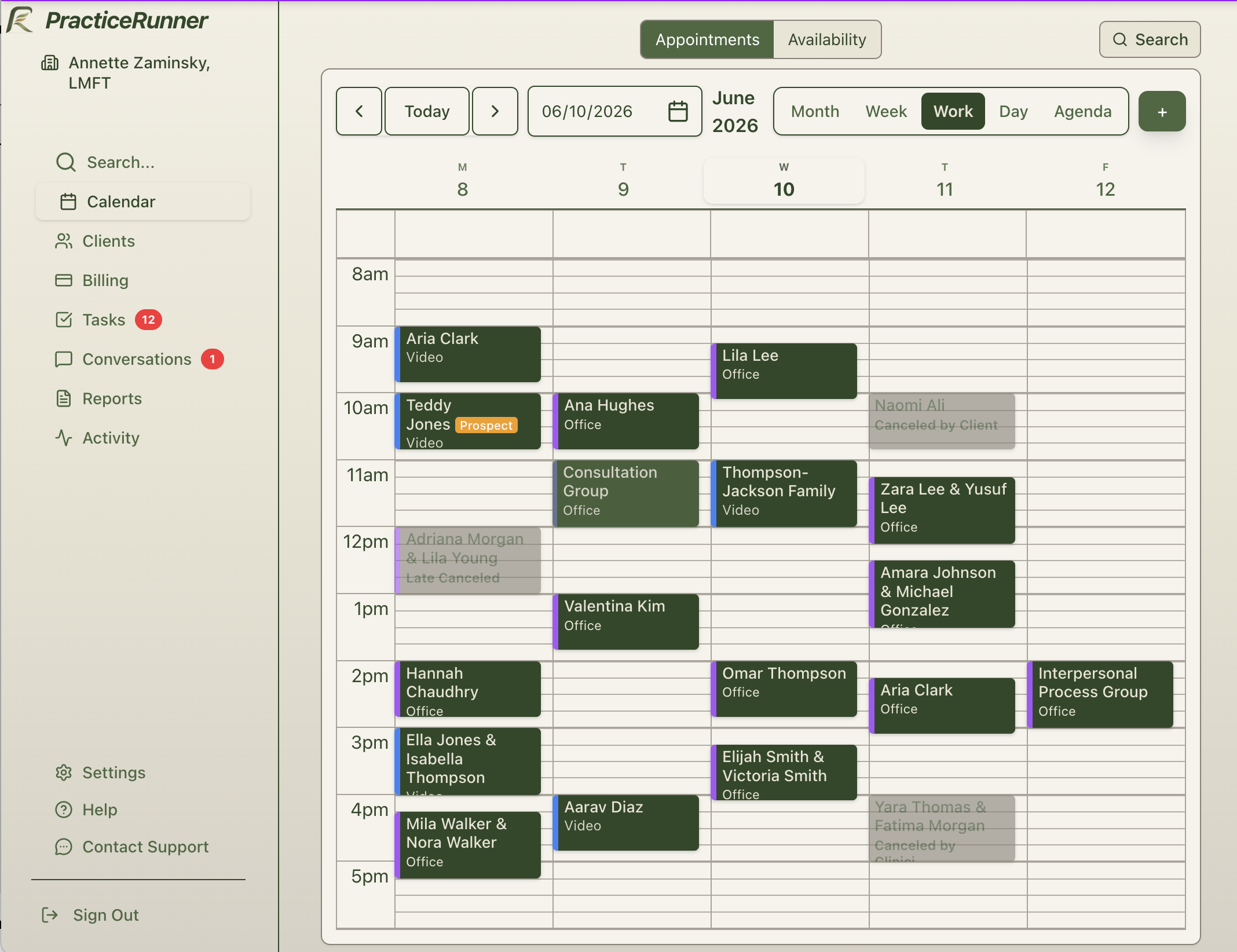
July included continued work on public service booking and the scheduler, along with improvements to Google Calendar synchronization. Calendar views can be filtered by provider, which helps a clinician or group practice reduce visual clutter when several schedules share the same calendar.
PracticeRunner also added cross-practice busy-time sharing. A clinician who works in more than one practice can make occupied time visible to another PracticeRunner organization without exposing the client or appointment details behind it.
Consultation became a first-class case type
PracticeRunner now supports individual consultation and consultation groups as distinct kinds of cases. These workflows retain the practical tools consultation work needs, including scheduling, invoices, payments, communication, agreements, and consultation notes.
At the same time, consultation cases do not default to psychotherapy-specific workflows such as diagnoses, treatment plans, insurance claims, and superbills. This makes it possible to manage billable professional consultation without pretending that a clinician receiving consultation is a therapy client or patient.
Billing work focused on reliability
A large share of July's billing work happened below the surface. Payment records and invoice status handling were strengthened, Stripe reconciliation and dispute handling were improved, and core financial amounts began using whole-cent values behind the scenes. That reduces the risk of rounding errors and inconsistent totals as reporting becomes more capable.
Bank-transfer payment states and invoice payment history also became clearer, including better handling for pending and cancelled attempts and for credits that have not yet been allocated to an invoice.
CMS-1500 preparation improved as well. July's work added stronger validation, appointment-level place-of-service and modifier handling, authorization details, clearer correction links, and batch PDF support for valid claims. This remains a claim-preparation and manual reconciliation workflow. Electronic submission, eligibility checks, and automated remittance are further-out roadmap items.
Migration review makes uncertain results visible
PracticeRunner added a review workflow for SimplePractice imports. Instead of treating a completed import as a black box, the practice can inspect the result, identify items that need attention, and work through the transition more deliberately.
This supports the way I think most practices should approach a switch: start with a representative set of active clients, review the imported information, use both systems for a period when appropriate, and expand after the new workflow has been tested in real use.
Read: Switching EHRs can be terrifying. You do not have to do it all at once. →
The Practice Website Review launched
Near the end of July, I launched the free Practice Website Review. It examines a therapist's public website for practical issues involving search visibility, accessibility, inquiry paths, mobile use, and the clarity of the next step for a prospective client.
The first version already distinguished between findings observed directly on the site and items that required manual confirmation. It also included platform-aware guidance, search-indexing checks, AI-crawler controls, and a more useful report structure. Work on the review continued after July closed, so the current version is more capable than the initial release.
The Practice Website Review is free and does not require an email address to run. The report identifies specific items to check and gives you a practical starting point for improving the site.
Review your websiteWhat's next
The next priorities are increasingly clear.
I want to keep deepening the Session Workspace so preparation, documentation, and follow-up work as one connected process. Financial reporting is also moving up the roadmap, with clearer views of receivables, payments, adjustments, collections, and practice-wide activity. Group-practice operations, including supervision and broader operational reporting, are becoming more important as I work with larger practices.
Electronic claim submission and related clearinghouse connections remain on the roadmap, but they are further out. The nearer-term billing work is financial visibility and continued improvement to the claim-preparation tools already in PracticeRunner.
I also want switching to PracticeRunner to become increasingly low-risk: better imports, better review, smaller initial migrations, and direct support when a practice's workflow exposes something the product does not yet handle well.
There will always be another feature to build. The more important question is whether PracticeRunner makes the actual work of running a therapy practice clearer and more manageable.