
Superbills for Insurance Reimbursement
How to create, send, and manage superbills for clients who submit out-of-network insurance reimbursement requests.
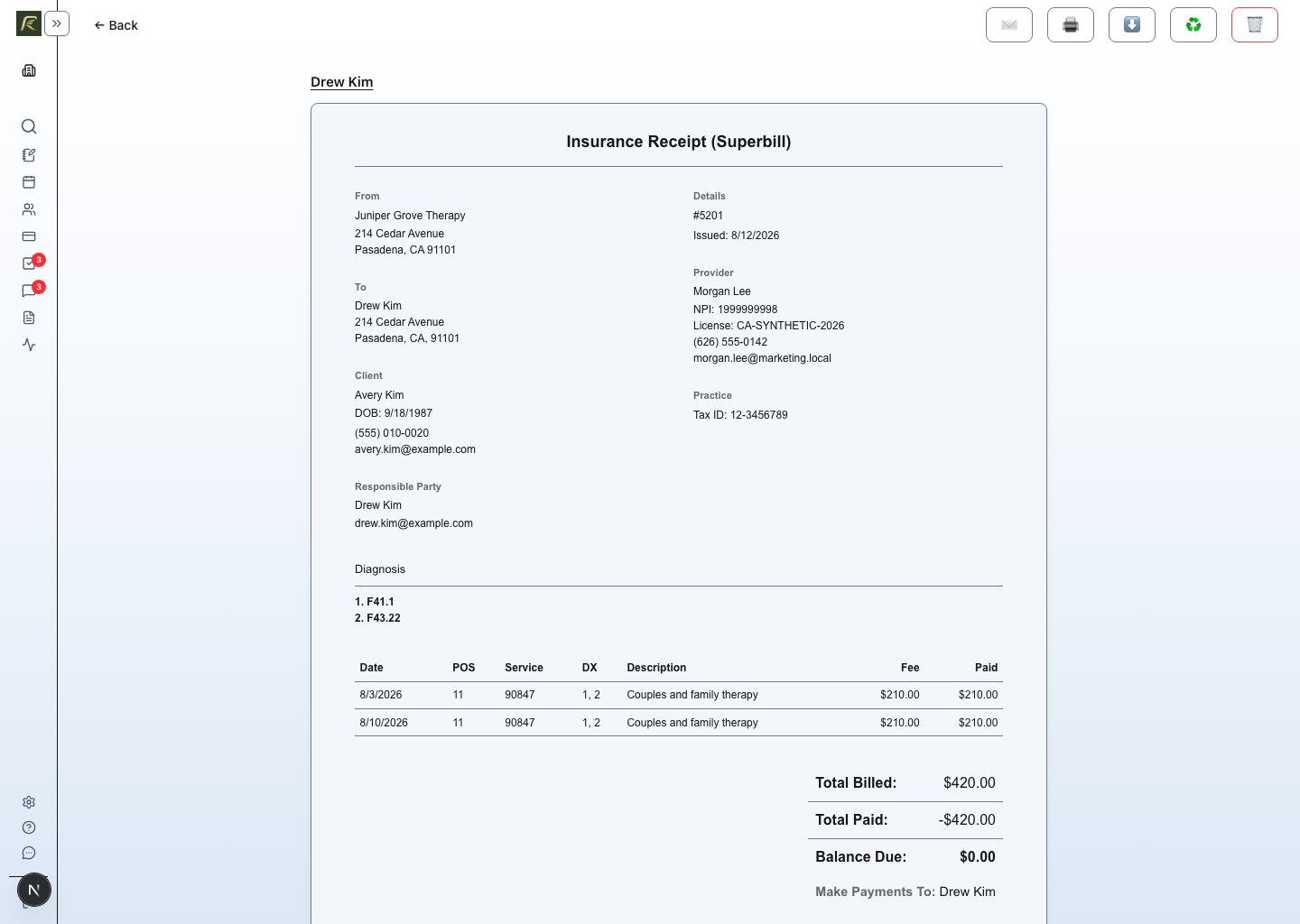
Superbills help clients request out-of-network reimbursement from their insurance plan. PracticeRunner can create a superbill from completed appointments, client demographics, diagnosis details, service codes, provider billing information, and recorded payments.
Superbills are different from invoices and CMS-1500 claim forms:
- Invoices request payment from a client or billing contact.
- Superbills document services and payments so the client can submit reimbursement paperwork to their insurer.
- CMS-1500 claim forms prepare a claim PDF for practices that need the standard insurance claim form format.
- Good Faith Estimates estimate expected charges for clients who will not use insurance claims for the care covered by the estimate.
Before Creating Superbills
Check that the billing and clinical details are complete before creating a superbill:
- Go to Settings → Billing and confirm your practice billing details, tax ID, and invoice footer details are accurate.
- Add provider billing identifiers where needed, including NPI, license, taxonomy, and provider tax ID or SSN if your practice uses provider-specific billing details.
- Confirm the client’s demographics and diagnosis information.
- Confirm that appointment services have the correct CPT codes and fees.
- Confirm each location’s place-of-service code and modifier-code defaults in Settings → Locations.
- Record any payments that should appear on the superbill.
For a couple or family case, choose the Identified patient in the case settings before turning on Make superbills available for this case. The identified patient is the person whose clinical and insurance details apply to the reimbursement document. PracticeRunner does not allow superbills to remain enabled for a couple or family case without that selection.
The identified patient and billing contact serve different purposes. The identified patient supplies the patient context for the superbill. The billing contact is the person who receives billing communication and the superbill link. They may be the same person, but they do not have to be.
For service categories, procedure-code setup, and insurance-service approval, see Setting Up Services, Fees, and Procedure Codes. For ICD-10-CM lookup and assigning diagnoses to clients, see Managing Diagnosis Codes and Client Diagnoses.
Consultation cases do not use superbills by default. Consultation work usually uses invoices and receipts instead of psychotherapy reimbursement documents.
If a client will not use insurance claims or receive superbills for this care, a Good Faith Estimate may be the more appropriate document to send before or near the start of care. Send it through Share Documents & Forms so PracticeRunner can create a saved estimate snapshot.
Place of Service and Modifier Codes
Place-of-service and modifier codes can appear on both superbills and CMS-1500 claim forms. PracticeRunner normally uses the defaults from the appointment location.
To use different codes for one appointment:
- Open the appointment from the calendar.
- Find Insurance billing.
- Select Use a different place of service, then choose the appropriate labeled code.
- Select Use different modifier codes when needed. Enter up to four codes, using one two-character code in each box.
- Save the appointment.
Use appointment-specific overrides only when the service was delivered differently from the location defaults or when a payer requires different reporting. Confirm coding requirements with the payer. If you change these details after creating a superbill, regenerate the superbill so its saved document reflects the updated appointment.
Creating a Superbill
To create a superbill manually:
- Open the client’s profile.
- Go to the client’s Billing section.
- Choose the date range to include.
- Click Create Superbill.
PracticeRunner includes completed sessions in the selected date range. Chargeable late-canceled sessions can still be invoiced, but they are not included on superbills.
After the superbill is created, you can review the document, download the PDF, email the client a link, regenerate the document if details changed, or delete it if it was created by mistake.
Monthly Superbill Automation
If a client is set to receive superbills, PracticeRunner checks for monthly superbills as part of billing automation.
For eligible prior-month appointments, PracticeRunner creates or updates one monthly superbill. If the superbill has not been sent before, PracticeRunner emails the client a link. If it was already sent, PracticeRunner updates the record without sending it again.
This lets practices support clients who regularly submit out-of-network reimbursement paperwork while keeping staff review available when needed.
What Clients Receive
When a superbill is sent, the client receives a link to view or download the superbill PDF. The PDF includes service and reimbursement details such as appointment dates, CPT codes, diagnosis pointers when available, provider information, paid amount, and billing details.
If secure portal messages are enabled, the superbill can be sent through the portal. If secure messages are off, PracticeRunner sends the email directly and keeps a copy in Conversations when supported.
When to Use CMS-1500 Instead
Use a superbill when the client is responsible for submitting reimbursement paperwork to their insurer.
Use a CMS-1500 claim when the practice needs to prepare the standard insurance claim form PDF and track the payer’s response. Claim actions are available from case-specific Billing pages and eligible invoices when claim forms are enabled in Settings → Billing. See CMS-1500 Claims and Payer Responses for the claim and manual reconciliation workflow.
Use a Good Faith Estimate when the client will not use insurance claims for the care covered by the estimate, such as self-pay care. Do not use it as a reimbursement document.